Eco Local Guide

Living Off the Grid - A Local Love Affair

By Stacey Allen
Contributing Writer

Tom Stock In front of his home


This time of year, more than ever, there's probably not one among us that hasn't imagined being off the grid... not having to worry about the cost of heating our home throughout the winter chill. Tucked away in the middle of 80 acres on the borders of Greenfield Center and Corinth, photographer Tom Stock and his wife, Roberta, are living just that life.


aerialview.jpgDining Room at Stock's Home
During the ice storm that hit our area hard in December, while most of us were facing days without power or fear every time the lights flickered, the Stocks were safely tucked in into their home, not aware that everyone around them was powerless and not concerned that their power lines might be clipped by a falling branch.

The idea for their self-sufficient home began several years ago when they were looking to combine their households. Both resided in Saratoga Springs, and instead of moving one into the other's home, they wanted to start fresh. While they could have bought an existing residence, Stock has always been interested in living out in the country which would be a perfect complement for his work. Because of this they began to look for land.

Originally intent on finding a 20-acre parcel, they had difficulty locating exactly what they were looking for. Ultimately, they ended up falling in love with the 80-acre keyhole plot. With only 60 feet of road frontage and a long and winding driveway leading to their property, and the nearest power line at one mile away, their new land was ideal for creating a completely self-sufficient home.

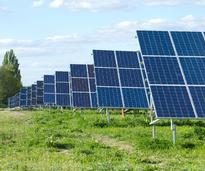
After much research on alternative energy and educating themselves, they settled on three complementary systems: a passive solar system which both powers and heats the home, a wind turbine and a backup propane generator. The three systems work hand-in-hand to assure they are never without power. The solar panels and windmill give them the ability to charge their battery cells via two methods and if it's cloudy and still for too long, the generator kicks in on its own. However they note, fortunately that happens rarely, if ever.

Since they moved into the home, on Valentine's Day 2005, they have not once had a problem, power outage or heating issue. And having lived in it in the day-to-day, they admit, there is nothing they would change about their setup.

When it came down to construction, it truly was a labor of love for both of them. Instead of relying on someone to fulfill their vision, they took the concept and worked on the design themselves. Seeing the home as somewhere they knew would never leave, they built for the future as well. Everything they need is on the main level and all the entrances and doorways are handicapped accessible.

Before construction even began, they had to clear a large area in the wooded property to make room for the home and to allow access to the sun for the solar panels and give the turbine the room it needed. To undertake the challenge, the Stocks had several tree-clearing parties, offering friends and family all the wood they could take and use for the added man power to help with the project.
aerialview.jpg


While Stock was on hand almost every day and was involved in every facet of the home's construction, they subcontracted out much of the work and actual implementation. Subcontracting proved to have its own challenges however, as they found themselves having to educate many of their subcontractors.

When it came time to get an engineer involved, they found that they had to hold fast on the orientation of the home while he was determined to give them what he considered the best view. The Stocks continually had to explain that the orientation had to be exact for the house to function properly. If the solar panels and the main bank of windows was not facing due south, they would lose out on the home's efficiency. As they went on, they found they regularly were sharing the knowledge they had gained with those working on their home that had never taken on such a project before.

The home is not just the wind turbine, solar panels and generator however, at least when it comes to heating. With the majority of its windows facing south, the home benefits from optimum sun intake. The dark slate floors absorb the sunlight throughout the day, allowing them to radiate the heat throughout the day.

During the construction phase, Stock used Structural Insulation Panels (SIPs) and caulking to help with the homes heating efficiency. This heavy insulation effectively seals off the home, keeping it free of all drafts and leaves it feeling comfortable no matter the temperature. According to Roberta, between 62 and 66 degrees, the house can easily feel more comfortable than a drafty home at 70 degrees. The insulation also serves to keep the house cool during the summer. Instead of turning to an air conditioning unit, the Stocks' home remains comfortable during the summer sun, even with the wide bank of windows thanks to the insulating job.

A major feature of the main living space is the gorgeous masonry heater that fills the kitchen and living room. The heater is faced with field stones from around the property. Using the stones from the property tied the stove into a concept Stock very much wanted to follow in the construction of their home... bringing the surrounding nature and their environment to the indoors, essentially tying the two together. This concept can also be found as structural features throughout the home in stock utilized trees that had been cut down to make room for the homestead as stair bannisters and structural posts.

Dining Room at Stock's Home


The 3-ton masonry heater, which Stock built himself, from a kit, is highly efficient. The fire only needs to burn for two hours and once it goes out, the stove's large surface will continue to radiate heat for up to 9 hours. The stove's high efficiency is seen most strongly in its wood consumption. Using the stove once a day for an entire season, the Stocks only used approximately 1.5 cords of wood, whereas a normal wood stove would go through 10 or more.

While they note that their setup would not be ideal for a larger family or consumes energy at a higher rate, it is perfect for them and keeps the cognizant of how much power they consume on a regular basis. Having the ability to see how much electricity they are using and how their battery charge is holding up, they find they are much more aware of how much energy they consume.

To conserve and otherwise save energy, they are regularly in the habit of reducing their phantom loads. These phantom loads, the ones that continually draw from your energy supply whether they are in use or not, contribute for a lot of what the rest of us get charged for regularly.

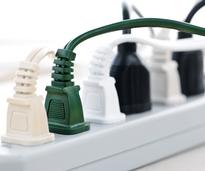
Things like cell phone chargers, televisions, computers, stereo systems and microwaves regularly draw energy even when not in use. Because of this, the Stocks have placed all these items on power strips that have on/off switches and can be shut off when not in use, saving them the regular draw.

This lifestyle also carries over to their commute as well. When they were living in town, Stock drove a Ford Explorer and thought nothing of his few mile commute or having to run to the store to buy something. However, now that his commute is much longer, he decided it was time to find a more fuel-efficient vehicle to take the trip daily. These days, the Stocks commute into Saratoga together and Roberta leaves her car at her office for around town errands. They have also found that living away from stores, they are forced to plan their trips around and to town more thoroughly.

Looking back at when they started the project, the energy crisis wasn't the hot topic it was these days and they find it interesting that now that we've begun to see gas and energy prices rise, that people assume that the work they've done was in response to the current situation. Indeed they were ahead of the curve when they began planning, but now that we have found ourselves in the situation we're in, they are certainly thankful they had the foresight.

Leave a comment

Leave a Comment