🌿 Saratoga Has Always Been About Restoration
Long before wellness became a trend, Saratoga was already known as a place of renewal — somewhere people sought out to rest, restore, and reconnect with themselves.
There’s something about Saratoga that naturally invites its inhabitants to breathe deeper, move slower, and feel a little more grounded. Perhaps its the mineral springs, tree-lined trails, slower rhythms, and peaceful atmosphere that creates the feeling that it is still possible to truly unwind here.
And perhaps that matters now more than ever.
💻 Focus Is Not Just About Attention
Modern life asks us to hold more information, stimulation, and emotional input than ever before, often without enough space in between to truly reset. Over time, this level of constant engagement can start to wear on mental clarity, focus, and follow-through.
And on top of that baseline digital strain, there are often other layers involved that all influence how the brain is functioning. These include stress resiliency, sleep quality, nutrient status, hormonal shifts, and day-to-day lifestyle patterns.
As a result, when attention wavers, it is often not from a single cause. Rather, it is from too many demands converging at once.
🌲 Why Saratoga Matters in a Digitally Distracted World
When attention is constantly pulled in multiple directions, environment starts to matter more than we usually give it credit for.
Saratoga offers something many people don’t realize they’re lacking in daily life — fewer competing inputs. More space between stimuli. A slower sensory field.
Walking through Saratoga Spa State Park, sitting near the mineral springs, spending time in nature, or simply stepping out of constant digital engagement gives the brain something it rarely gets anymore: uninterrupted processing time.
And that shift is not abstract. It’s sensory.
Sound softens. Visual input becomes more natural and less fragmented. The pace of movement changes. Even breathing tends to deepen without effort.
It’s the kind of environment that doesn’t “fix” attention — but it stops adding to the overload.
🌸 The Role of Scent in Cognitive Clarity
Once the environment begins to quiet down, another sensory pathway becomes more noticeable — scent.
Smell has a direct line to areas of the brain involved in memory, emotion, and attention. It doesn’t pass through the same filters as other sensory input, which is part of why it can shift mood and mental state so quickly.
This is also why certain natural scents — pine in the trees, mineral fresh-air, the damp earth after rain — can make you feel more grounded and alive without effort. The body responds before there’s even time to analyze it.
In more intentional wellness practices, this same pathway is often supported through essential oils. Not as a replacement for environment or lifestyle, but as an additional sensory cue that helps guide the brain into a different state of focus, calm, or alertness depending on what is used.
It simply adds another layer that the brain can recognize and respond to.
🌿 Bringing It Into Practice
This is where scent becomes more than a background experience.
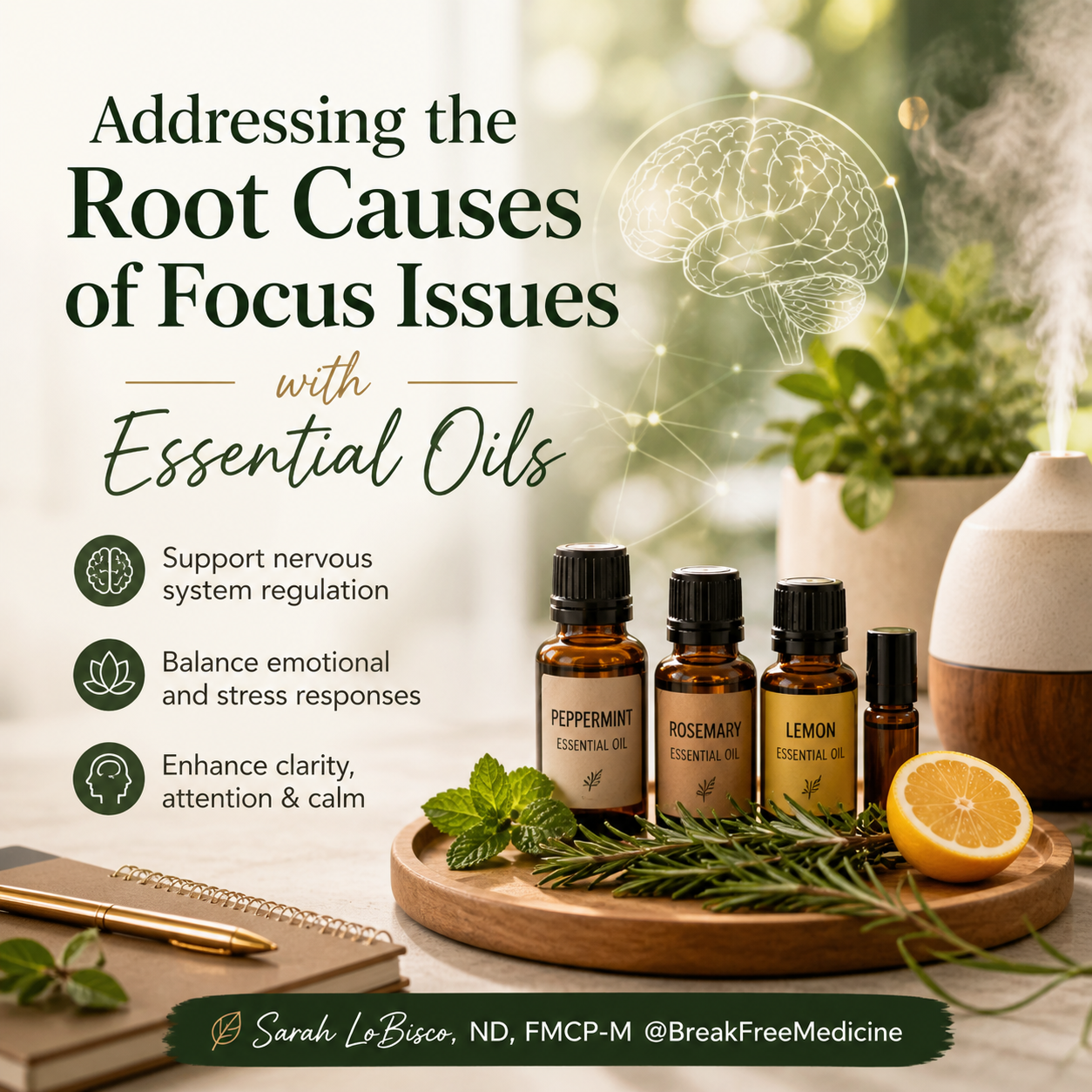
Essential oils work through sensory pathways that are closely tied to mood, memory, and regulation. This is part of why they’ve long been used for supporting cognitive and nervous system function, and why I use them as integrative tools in my naturopathic and functional medicine practice. They interact directly with how the brain processes internal and external cues that shape attention, alertness, and recovery.
Certain oils are used to support a clearer, more alert mental state during the day. Others are traditionally used to help cue the body toward rest in the evening, when sleep and recovery take priority.
And they tend to be most effective when they are part of a broader environment that already supports regulation. Time outside, slower settings, and places like Saratoga naturally reinforce this nervous system reset.
It’s often in that combination — sensory input, environment, and physiological rhythm — that attention is enhanced.
If you want to go deeper into how cognitive clarity, mental energy, and focus are influenced by physiology and sensory input — including five essential oils I often work with in practice — you can read the full article here:
👉 Why Can’t I Focus? Part 2: Five Essential Oils to Boost Focus, Energy, and Cognition Health
🌿 Saratoga as a Restorative Environment
What Saratoga offers, in a consistent way, is space for the nervous system to come out of constant input.
Not by removing life’s demands, but by softening the background intensity just enough that the body can begin to recalibrate. Time in nature, movement through the parks, the presence of water, and even the slower rhythm of the town all contribute to that shift.
For many people, this becomes the piece that makes everything else more effective — including sleep support, stress regulation, and sensory tools like essential oils.
And when attention has been pulled in many directions for too long, that kind of restoration stops feeling optional and starts feeling necessary.