
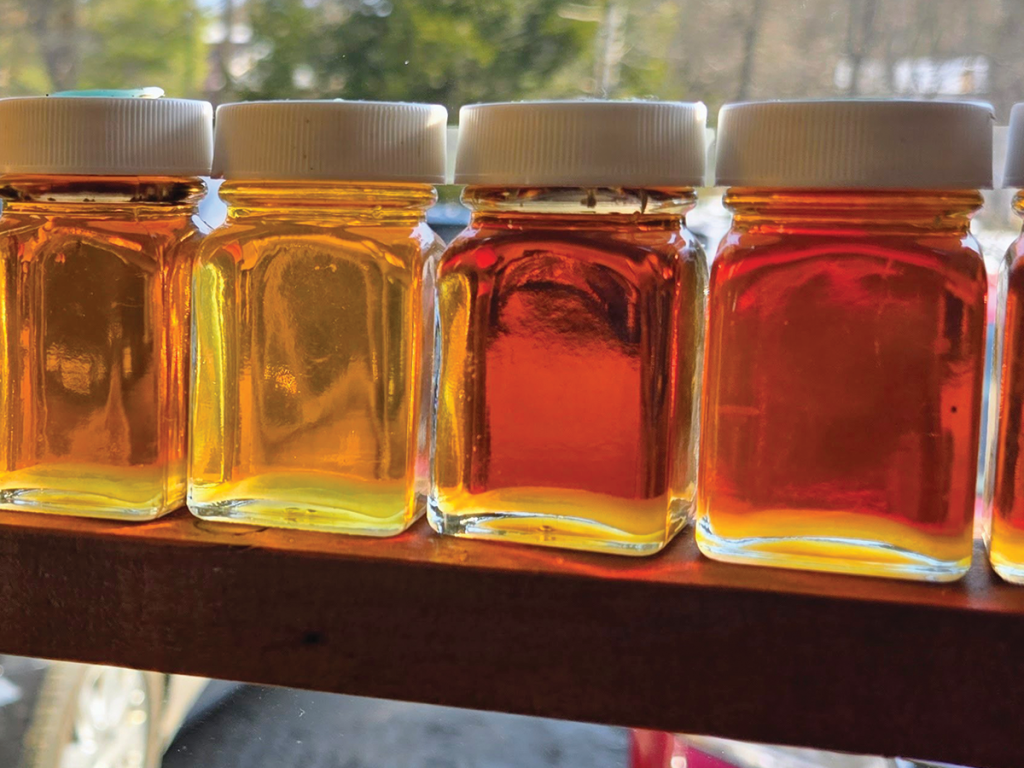
Courtesy Paul Post
By Paul Post
Maple producers comprise a pretty tight-knit community, always willing to lend a helping hand.
Just ask Ryan Veitch, who started making syrup eight years ago at his family’s 191-year-old, eighth-generation Twin Leaf Farms at 200 Hyspot Road in Greenfield Center.
“In 2019 we added a parcel of land that had sugaring on it,” he said. “That’s when we jumped back into full-time farming here. The property had aging maple infrastructure on it and the owner wanted to sell. It was next to our property so we bought it to keep it green instead of someone building another housing development. That’s when we decided to revamp and modernize the maple operation.”
They did it with help from the Monica family, longtime owners of Maple Valley Farm in Corinth.
“They held our hand and helped us get set up the right way so we didn’t have to guess a million times,” said Ryan. “The first year or so they would truck all our sap up to their place and boil it. Over time we added our own equipment and made it in-house.”
“We’re super fortunate that they were there to help us out in the beginning because I had never done any of this before,” he said. “It was a totally new thing. I did a lot of ‘YouTube university’ to figure out what we were doing. They helped us out big time.”
Ryan runs Twin Leaf Farms with his brother, Jake, who lives in the original family homestead, built in 1826.
From humble beginnings, they’re now tapping 2,000 trees with plans for significant expansion to keep up with fast-growing demand. “We’re at the point now where we have to expand because we’re running out,” Ryan said.
On the weekend of March 21-22, Twin Leaf Farms will host an open house pancake breakfast from 9 a.m. to 2 p.m. both days, with live music. The $5 fare includes pancakes, syrup and a beverage served in take-home style containers. Limited seating is available.
“Last year we served 850 breakfasts,” he said. “It was unbelievable.”
In addition to maple season, the brothers have planted thousands of Christmas trees that will be ready for harvesting in a few years, along with property maintenance for various clients.
Taking a cue from the Monicas, when setting up their maple operation they purchased a modern, wood-fired evaporator used to boil sap into syrup. Wood burning is more traditional compared with gas-fired evaporators and Ryan believes it also enhances syrup’s flavor.
In addition, they use reverse osmosis technology, which removes most of the sap’s water content prior to boiling. This makes boiling much quicker and greatly reduces the amount of wood needed.
“We can boil 2,000 gallons of sap in just a few hours,” Ryan said.
Steam billowing from sugarhouses is a common sight throughout upstate New York and New England in March.
With more than 2,000 sugar makers statewide, New York is the nation’s second-leading producer behind only Vermont, and the industry generates an annual economic impact of about $141 million.
The industry in New York state is growing 7 percent annually, fueled by increased demand both domestically and globally from countries such as China and Japan. New York has produced more than 800,000 gallons of syrup in six of the past eight years, including a record-high 846,000 gallons in 2024.
Production has more than quadrupled since 2001 (193,000 gallons) thanks in part to state funding for marketing and research and legislation that has opened some state-owned land to sugaring.
Taste NY markets promoting maple are set up at key locations throughout the state this month, including the Adirondack Welcome Center between Northway Exits 17 and 18 northbound. Maple samples will be available there from 11 a.m. to 1 p.m. each Thursday in March. The welcome center will also host a “From Sap to Syrup” event from 11 a.m. to 4 p.m. Friday, March 20.
Visitors may sample maple products, and there will be educational and interactive displays. Samples of maple lattes and locally made maple hot cocoa will be sold on-site.
Ideal sugaring conditions are warm days with temperatures in the 40s and 50s followed by cold nights down to about 25 degrees. This cycle creates pressure within trees that makes sap flow.
A deep snowpack such as this year’s helps cool things down at night.
“If we had bare ground and 60 degrees I’d really be worried,” said Tim Monica, a fifth-generation producer of Maple Valley Farm in Corinth.
Business has been so good the past few years that he plans to acquire two new sugarbushes this summer and more than double his operation from 2,600 taps to nearly 6,000 taps. “After COVID, everybody’s been going back to more natural things, anything they can get from a local producer,” he said.
In addition to on-farm sales, Maple Valley syrup is found at outlets such as King’s Dairy in Northumberland, Smith’s Orchard Bake Shop in Charlton and Saratoga Winery in Saratoga Springs, whose chef uses maple for a variety of dishes. Monica also takes product to Saratoga County Fair and farmers markets in Glens Falls, Saratoga Springs and Chestertown.
Monica runs Maple Valley Farm with his daughter, Abigail, and his brother, Scott. He learned the business from his late father, Don, who began making syrup as a young boy with buckets hung from trees, working at night to boil sap with light from kerosene lamps.
Many area producers are holding open house events the last two weekends in March.
“New York continues to be a top maple producer in the U.S. and our producers continue to make some of the finest, most innovative maple products in the country that contribute greatly to our economy,” state Agriculture Commissioner Richard Ball said. “I encourage New Yorkers to find a nearby, local producer hosting during Maple Weekends and join in this timeless tradition. This is truly one of the best times of year, as we gather with our communities across the state to support our maple producers.”
For a complete listing and more information about Maple Open House events, visit https://www.mapleweekend.com/.