
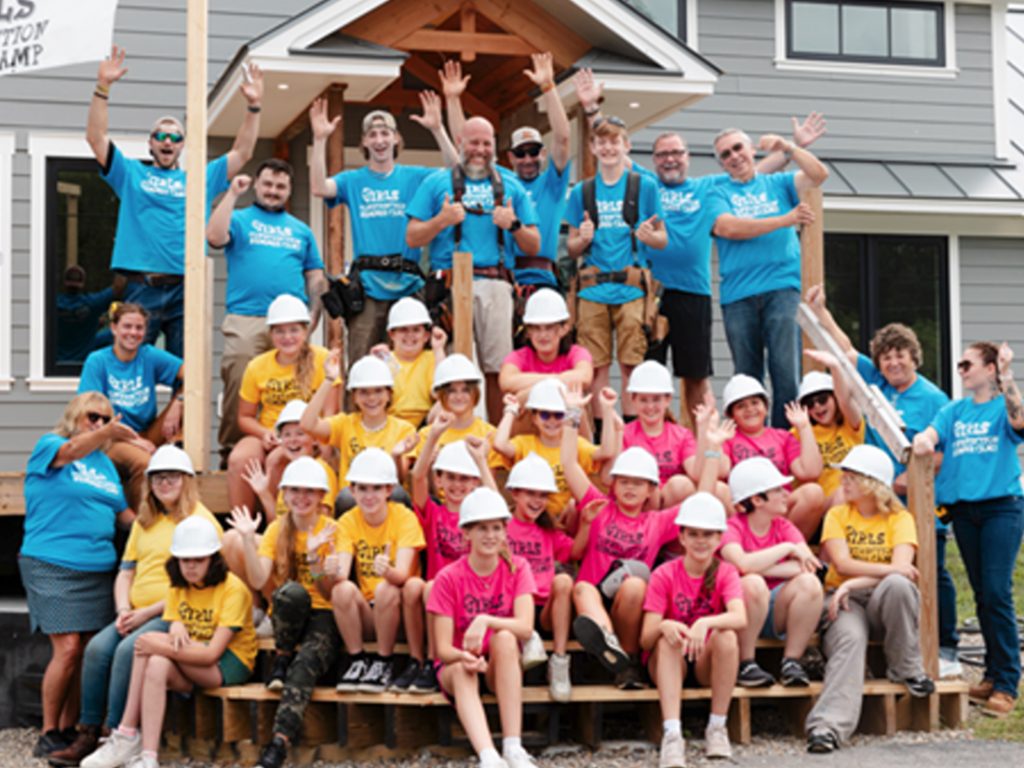
Courtesy NCTWC
By Susan Elise Campbell
Every building, road and bridge relies on workers with skills that artificial intelligence will not replace. As communities grow, they need more workers on job sites and behind the scenes.
High demand and relative job security make the construction trades attractive. But the workforce shortage has grown so severe it has been described as a national crisis.
In Saratoga County, a nonprofit serving the Northeast has spent the past eight years building awareness between young people and potential construction careers.
“At Saratoga Builders Association board meetings, builders would talk about how we could build more if we could hire more,” said Doug Ford, then president of and now senior adviser to Curtis Lumber Co. “I said we need to do something or take this off the agenda. I was immediately assigned to head a task force.”
Ford said that “on day two” as task force leader he brought in Pam Stott, also an executive of Curtis Lumber, and co-founded the group that received nonprofit status three years ago as the Northeast Construction Trades Workforce Coalition.
Today, Stott is executive director of NCTWC and its only paid staff member. Ford is president of the five-person board. The organization has 110 dues-paying members, primarily builders, suppliers and vendors, plus attorneys and insurers. It also has nonpaying relationships with 65 school systems and growing.
“Other industries go into schools and talk about job opportunities, so why not construction,” said Ford. “We were late to the table, but we’re showing kids first-hand the diverse jobs available.”
“We knew when we started we had to interactively engage young people in the classroom and put that seed of interest in their minds,” said Stott.
NCTWC’s hands-on programs serve students from second grade through college. Programs have been so well received that the board aims to franchise its structure and curriculum, Stott said.
“Starting a franchise business is a long process, it’s costly, and this is territory we have never explored before,” said Stott. “But we are working with legal people and an educational company to actually package how we approach schools and engage the students.”
During one-hour school periods, second through fifth graders build a toolbox and sixth through eighth graders build a dodecahedron. NCTWC also organizes Meet the Builder presentations at middle schools and high schools, local construction site tours, career exploration visits to member businesses, and a girls summer camp.
From the beginning, NCTWC has worked to overturn misconceptions about and biases against construction trades, the co-founders said.
A construction career does not have to mean field work, and many jobs are not as physical or risky as many believe, the experts said. Careers include designers, estimators, purchasers, logistics professionals and other behind-the-scenes roles.
School counselors play a key role in bringing tradespeople into schools, although they know little about construction and tend to steer students toward college, Stott said. But the coalition has made inroads.
“Parents have a similar misconception that children cannot have a lucrative or satisfying career without a college degree, whereas college can be a path to a construction career,” she said.
“We are not anti-college. We’re pro-learning and want kids to stay in school,” said Ford.
Ford got a call two years ago from someone whose son had dropped out of university in the first semester. The young man was at the top of his class at Saratoga, an athlete and an Eagle Scout, and had entered college only to please his parents. He was not going back.
“He wanted to work with his hands,” said Ford. “I set him up for two days with a remodeler, two days with a new home builder, two days with a commercial builder, and two days with the carpenters union.”
Ford told the young man that if he followed through, he would learn whether construction was what he really wanted to do.
“He joined a commercial construction company and became one of our younger members talking in front of classrooms until he moved away,” said Ford. “He told students he could drive around and say, I helped build that, and that motivated him.”
NCTWC arranges job shadowing and internships to help match anyone interested in learning about or transitioning to construction careers, said board member Matt Whitbeck, owner of Whitbeck Construction LLC.
“We connect them with the member who would be the best fit for this student given the project, location, and time frame,” he said.
Whitbeck, the face of NCTWC at schools, is an experienced instructor. For the past 12 years, he has traveled the world teaching building science, which studies how a building can affect the environment around it. His education philosophy is to “have fun and call out things people have forgotten,” he said.
“Students need passion and a belief they would gain satisfaction from a career in the trades,” he said. “It is humbling how they remind me why I got into construction in the first place.”
“As an employer, we don’t hire off a resumé,” said Whitbeck. “We are more interested in if they do puzzles, solve problems, or like math.”
All three board members said success is hard to quantify, although Whitbeck said “the students’ energies are a great metric.”
“They are dialed in, focused, and communicating verbally, which is so difficult for some kids today,” he said. “There is communal satisfaction seeing what they built together with their hands.”
Program and camp money comes from dues, small grants and fundraising events, such as last November’s mixer.
“Our biggest grant came from Representative Carrie Woerner,” Stott said. “She
approached us three years ago and specifically asked us to engage girls in middle school.”
The Girls Construction Camp will be offered again this year in late July and early August.
Visit nctwc.org to donate or become a member.