
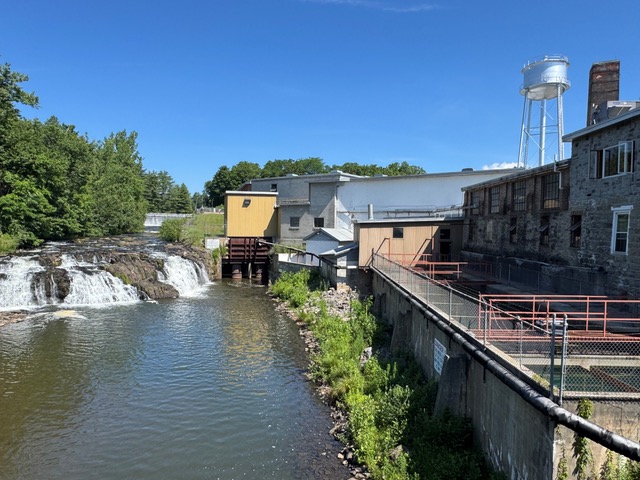
Courtesy Cottrell Paper Company
By Rod Bacon
Last month, Cottrell Paper Company celebrated a century of producing high-quality insulating papers for a variety of electrical applications.
The fourth generation of the family continues to operate the mill established by Frank Cottrell Sr. and his two sons, A. Frank Cottrell Jr. and James T. Cottrell, on Kayaderosseras Creek in Rock City Falls.
“We have a reputation for reliability, innovation, and superior craftsmanship,” said Chief Executive Officer Josh Cottrell. “We have proved that stewardship of place and people can outlast market swings and industry consolidations.”
Cottrell explained that in the early years the company focused on producing rag paper, a type of electrical insulating paper made from high-quality cotton fibers. With its proven track record of strength and insulating properties in electrical applications it was ideal for use in motors, transformers, and other electrical components as well as being a sustainable option. They continue to use this method, sourcing materials from overseas. The proprietary name for this material is Copaco.
“These are automotive and electrical insulating grades, he said. “It’s used mostly in small fractional horsepower (FHP) motors but there are a lot of automotive applications as well.”
In the 1990s the company introduced Cottrell Kraft, a product made from virgin fiber electrical kraft pulp. It is produced by treating wood chips with hot alkaline chemicals to dissolve the lignin that binds the wood fibers together.
Cottrell noted that the products made from cotton material are a bit stronger and more puncture resistant than those made from the kraft option, but clients that don’t need the properties of rag paper can choose it. It is slightly less expensive.
While a precise, universally agreed-upon consensus of every micro-manufacturer does not exist, 360 Research Reports identifies 30-50 globally recognized companies. Cottrell Paper is listed as a key U.S.-based manufacturer.
The mill has converting capabilities from its master rolls to produce sheets, rolls, and coils of various sizes to meet customer demands. They provide these to their clients, who manufacture the products they need.
“We’re small enough to manufacture products exactly the way the customer is looking for them,” Cottrell said. “They don’t have to just pick something off the shelf”
During COVID-19, when business slowed, the company met the challenge and kept all employees working. They made part of the nose piece for the N95 masks as well as developing products made from hemp. Marketed under the trade name Mill26, they manufacture hemp paper lunch bags, filter tips/crutches, paper drinking straws, and business cards. They bought a bag machine and can print a company’s logo on the purchaser’s bags.
“We were able to develop the world’s first thick one-hundred percent hemp paper made on a machine in a long time,” Cottrell said.
They are actively marketing the lunch bags to local companies and dispensaries.
Josh Cottrell’s brother, Jimmy, was a driving force behind the establishment of Mill26. As vice president/director of maintenance, he is responsible for keeping the manufacturing process running smoothly.
Business has increased significantly since the pandemic, requiring the hiring of additional employees that took the workforce from 38 last year to the current total of 50. The mill has gone from running five or six days a week to 24/7.
Cottrell attributes the increased need for their products to a growing demand for electrical power worldwide. He noted that electric cars are now a viable market segment and AI data centers are coming online. The populations of China and India are expanding rapidly, creating the need for more electricity.
“Those countries, as well as others, all need more transformers and a lot of our products go into wrapping wire inside those transformers. All this electrification requires us to supply more material. There’s a shortage of companies manufacturing transformers and they’re growing their facilities so we’re trying to grow our market share,” he said.
The Cottrells have always been excellent stewards of the environment, and numerous initiatives over the years have helped sustain it.
From the company’s inception they have utilized hydroelectric power produced by a small plant on Kayaderosseras Creek. In recent years it has contributed only a minor portion of the energy required, but there are plans to increase that in the future.
The raw materials for their Copaco and Kraft papers are sourced from post-manufactured waste, which decreases the demand for virgin fiber and reduces the landfill burden.
Internal recycling at the plant recaptures, repulps, and reincorporates all paper trim material into the manufacturing process.
The water used comes from the Adirondack Mountains and ultimately from the Kayaderosseras Creek.
“It’s very clean,” Cottrell said. “We pride ourselves on putting it back in the creek as clean as we took it out. We also believe that the cleanliness of the water gives us very pure paper for electrical purposes.”
Fifteen years ago, realizing that fuel oil prices were increasing, they took out a loan to run a natural gas line three miles to the plant and installed a high-efficiency boiler.
“Not only did this save us on fuel costs but it significantly lowered our carbon footprint by replacing more polluting heating methods,” said Cottrell.
Finally, all fiber waste that can’t be used is composted as a nutrient-rich soil enhancement.
For further information about Cottrell Paper Company go to cottrellpaper.com.