
Courtesy TickDetect
By Carol Ann Conover
When Tim Montgomery’s daughter made three visits to the emergency room in a single week, the diagnosis wasn’t the flu. It was babesiosis, a tick-borne parasite that attacks red blood cells. “She ended up spending three visits to the emergency room over a week with a temperature of north of 103 for the whole week,” Montgomery said. His sister also has battled Lyme disease for years, and his brother has been infected twice. “It’s just an awful thing,” he said.
Those family experiences, along with a tick Montgomery recently had removed from his back at Hudson Headwaters, led the Queensbury entrepreneur to build TickDetect, a free artificial intelligence tool that helps people — and their pets — check for ticks and tick-related rashes before the bites become more serious.
Montgomery founded TIMIT Solutions in January 2012 after a 20-year career at GE and a series of executive roles running global technology, health care and staffing businesses. The Queensbury-based firm primarily serves midsize companies, generally those with $10 million to $1 billion in revenue, by building custom software, modernizing legacy systems and offering chief information officer coaching and mentoring, Montgomery said.
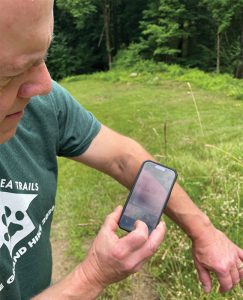
TickDetect, the company’s newest project, runs entirely in a phone’s web browser — no app store download is required. Users photograph their skin or a pet’s fur, and the tool uses Claude AI Vision to identify tick species, attachment status and rash patterns, generating a private report users can bring to a doctor or veterinarian. “There’s no reason to download an app at all,” Montgomery said.
Privacy was central to the design, Montgomery said. Photos are analyzed and then discarded rather than stored, and the tool collects no names or other identifying information unless a user opts in to share anonymous usage data. “It records no personal information. Nothing is ever stored. It’s totally encrypted,” he said. The platform is built to comply with European and California privacy regulations, according to Montgomery.
The idea grew out of a simple frustration, he said: It is nearly impossible to check hard-to-see spots such as the scalp or the middle of the back for a tick bite. “I thought, gee, it’s so hard to, you know, for example, look at the top of my scalp or the back of my neck or my back,” he said. TickDetect also works for dogs, cats and even horses, whose fur can make a bite easier to miss.
The tool is free during its public beta rollout in Warren, Washington and Saratoga counties, and Montgomery said a paid tier is planned at $4.99 a month for an individual or $9.99 a month for a family of five, with a limited free option remaining available. Montgomery said he also is considering developing an opt-in feature that would let users anonymously share their general location to help track tick density regionally. “I think that’s a great idea that I’m going to follow up with local agencies on that,” he said.
The region provides an obvious testing ground. Warren County sits in one of New York’s higher-incidence zones for Lyme disease, according to TIMIT Solutions, and the county began building its own tick-tracking website this year to monitor bite reports. The county’s tracker had logged nearly 240 ticks as of spring, according to Warren County Planning and Development. Statewide, New York has averaged more than 17,500 new Lyme disease cases annually over the past three years, with more than 19,000 reported in 2023 alone, according to the state Department of Health.
Montgomery, who grew up in the Glens Falls area and returned in 2014 after years working abroad, said he sees TickDetect as a natural extension of his technology career. “It’s nice to be back home and I like that I can help keep people safe while they enjoy this beautiful area,” he said. More information is available at timitsolutions.com/tickdetect.